Customization Is Still King , But the Rules Have Changed
This post is based on our presentation: “Four Pillars, Four Platforms: A Practical Comparison of Sitecore AI and Its Main Competitors.”
Since the full talk runs about 45 minutes, I’m breaking it into smaller pieces you can read on their own. Let’s start with one of the most important (and often painful) topics in DXPs: customization.
The Truth About Customization
If you’ve worked on any real DXP project, you already know this:
Customization never ends.
No matter how well things are planned, there’s always:
- one more feature
- one more business requirement
- one “quick” edge case that isn’t quick at all
And that’s fine. Customization is where the actual business value gets built.
The problem isn’t whether we customize: it’s how we do it.
The Old Way: Powerful… and Painful
For years, the approach was pretty straightforward. If you needed something, you built it directly into the platform.
That usually meant:
- extending core functionality
- overriding pipelines or components
- building custom modules deeply tied to the system
And to be fair, it worked. You could build almost anything.
But there was always a catch (and usually a big one).
Over time, projects would start to feel… heavy.
- Upgrades became stressful and unpredictable
- Only a couple of developers really understood what was going on
- Small changes had unexpected side effects
- Maintenance costs kept creeping up
I’ve seen projects where upgrading the platform felt closer to a rewrite than an upgrade.
What started as flexibility slowly turned into long-term friction.
SaaS Changed the Game
That old model doesn’t survive well in a SaaS world.
Modern DXPs don’t sit still anymore. They evolve constantly:
- updates are frequent
- changes are automatic
- and you don’t control the timing
Which creates a new reality:
If your customization is tightly coupled to the platform, it’s going to break. Maybe not today, but eventually.
And “upgrade projects” as we used to know them? They’re basically gone. You’re now in a state of continuous change whether you like it or not.
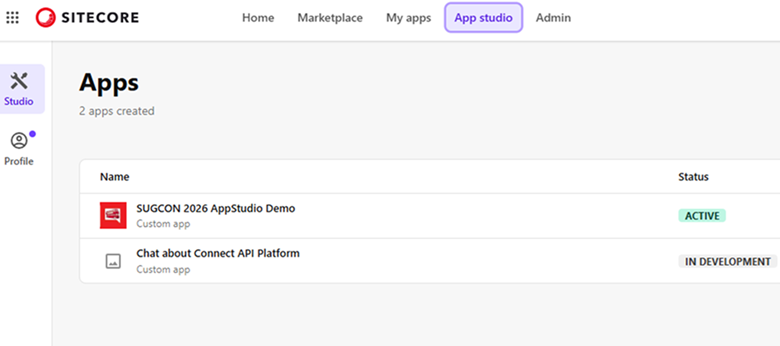
Enter App Studio (and Why It Actually Matters)
This is where App Studio comes in, and honestly, it’s more than just another feature. It’s a shift in mindset.
Instead of modifying the platform itself, you build around it.
That means:
- creating extensions outside the core system
- using APIs and events instead of internal overrides
- keeping your logic separate from platform internals
A simple way to think about it: Stop customizing inside the platform. Start extending around it.
What Actually Changes
The difference is bigger than it sounds.
Before:
- Custom code lived inside the platform
- Everything depended on the platform version
- Upgrades were risky and expensive
Now:
- Customizations live as independent apps
- Communication happens through APIs
- Upgrades are far less dramatic
This isn’t just a Sitecore thing either, it lines up with where the industry has been heading for a while:
- composable DXPs
- API-first design
- modular architectures
Why This Approach Works Better
1. Upgrades Stop Being a Nightmare
When your code isn’t tightly glued to the platform, updates stop breaking everything.
It’s not magic, you still need to be careful, but the risk drops significantly.
2. Teams Move Faster
You don’t have to wait for platform release cycles anymore.
You can:
- build features independently
- deploy faster
- experiment without touching the core system
That’s a big deal in real projects.
3. Less Long-Term Mess
Deep overrides always come back to haunt you.
Keeping things decoupled doesn’t eliminate complexity, but it makes it manageable.
4. It Opens the Ecosystem
This is an underrated benefit.
When everything is modular:
- components can be reused
- apps can be shared
- marketplaces actually become useful
Customization stops being a closed, internal effort.
Let’s Be Honest: Customization Isn’t Going Anywhere
Even with App Studio, nothing really changes in one key area:
There will always be more to build.
Every business is different. Every digital experience needs something unique.
Customization is still the differentiator.
The difference now is that we have a way to do it without constantly fighting the platform.
Where This Fits in the Bigger Picture
In the broader view, App Studio is just one part of a bigger shift in how DXPs are evolving:
- Customization → App Studio
- AI & Automation → Agentic capabilities
- Ecosystem → Marketplaces and integrations
- Connectivity → API-first layers
Out of all of these, App Studio is the foundation. If customization isn’t handled well, everything else becomes harder.
Final Thought
Customization isn’t going away, in fact, it’s becoming more important.
But the approach has to change.
We’re moving:
- from monolithic to composable
- from tightly coupled to loosely integrated
- from risky upgrades to continuous evolution
And honestly, that’s a good thing.
Because at some point, every team learns this the hard way:
The more you change the core, the more the core fights back.
Better to build around it.


