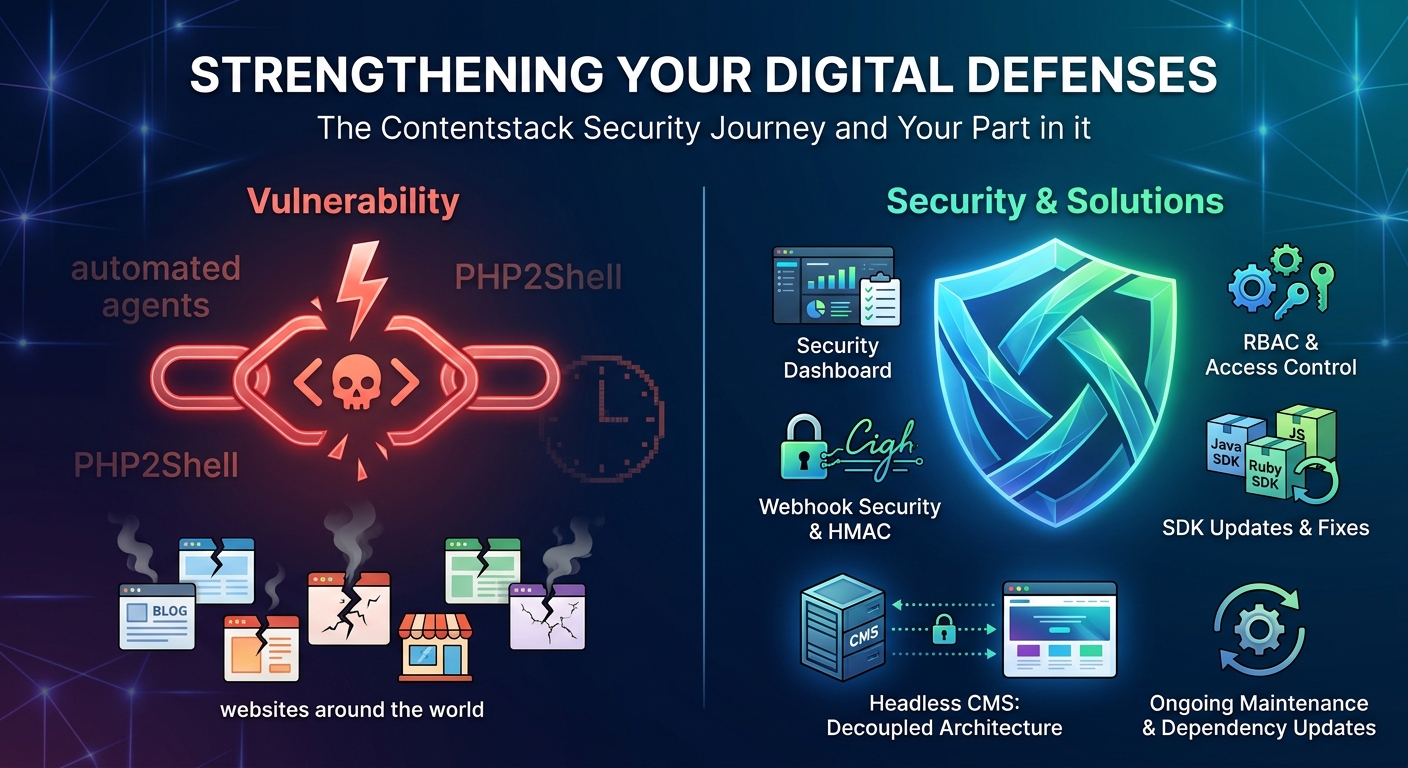
Last week, we saw a major security issue affecting websites around the world. It was another reminder of how vulnerable our websites can be, especially in the age of AI, where automated agents can potentially find and exploit vulnerabilities across thousands of websites in a short time.
Two critical PHP vulnerabilities, known as PHP2Shell, raised serious security concerns, leading many companies and organizations to temporarily shut down their websites as a preventive measure.
This got me thinking about how important security has become, especially for those of us working with CMS platforms and building digital experiences.
I’ve been following the latest updates from Contentstack, and it’s interesting to see some of the security improvements they have introduced throughout 2026.
Here are a few worth mentioning:
- Security Dashboard: A new place to check security risks, inactive users, MFA, and user permissions.
- Role-Based Access Control (RBAC): Better control over what users can access and manage.
- Webhook Security: Improved protection using HMAC signatures and key rotation.
- SDK Security Updates: Several fixes for vulnerabilities in Java, Ruby, and JavaScript SDKs.
- Adaptive Rate Limiting: Better handling of unexpected increases in API traffic.
Does Using a Headless CMS Make Your Website More Secure?
I believe a headless CMS can help improve security because the content management system is separated from the frontend application.
But this doesn’t mean your website is automatically secure.
Even if you are using Contentstack, you still need to keep your frameworks, SDKs, and other dependencies updated.
For example, if your frontend is running on a vulnerable PHP version, using a headless CMS won’t protect you from that vulnerability.
Final Thoughts
The PHP2Shell incident is a good reminder that security is something we need to think about all the time, not only when something goes wrong.
It’s good to see Contentstack investing in security improvements, but as developers and architects, we also have our part to do.
At the end of the day, having a secure CMS is important, but keeping the entire solution secure is what really matters.


